Students & Postdocs
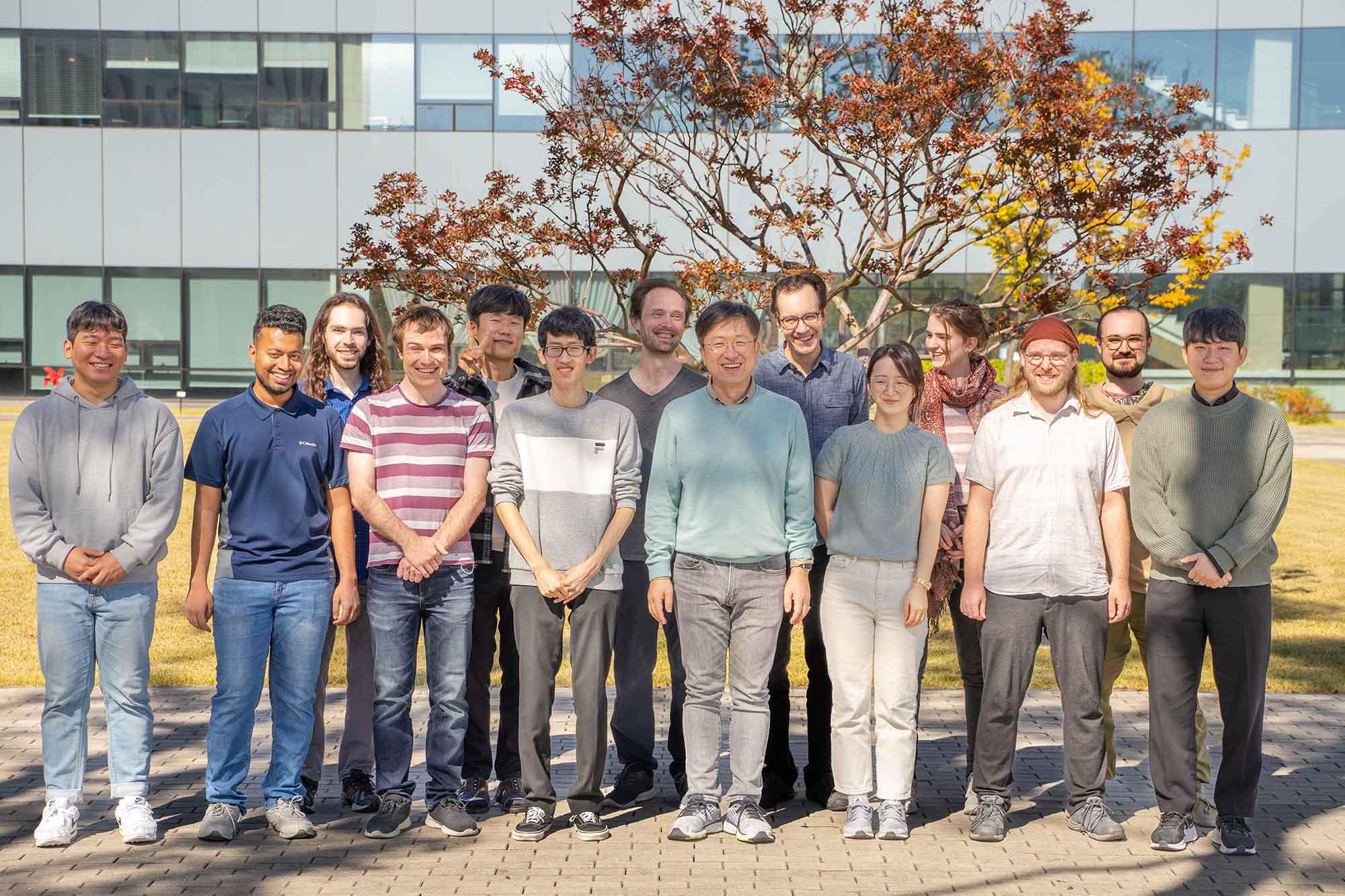
Current Graduate Students


Current Postdocs







Former Graduate Students
- Ph.D.
- O-joung Kwon권오정.
Ph.D. 2015.8, M.S. 2012.8. (Currently, an Associate Professor at the Department of Mathematics, Hanyang University)
PhD thesis: On the structural and algorithmic properties of linear rank-width - Jisu Jeong정지수.
Ph.D. 2018.2, M.S. 2013.8. (Currently, a Data Scientist at Naver Corporation. Previously at Watcha and SAMSUNG SDS)
PhD thesis: Parameterized algorithms for width parameters - Dong Yeap Kang강동엽.
Ph.D. 2020.2, M.S. 2016.2. (Currently, a Postdoctoral Fellow at KAIST)
PhD thesis: Graph Decompositions and Related Extremal Problems - Duksang Lee이덕상.
Ph.D. 2023.2. (Currently, working at Woowa Brothers우아한형제들. Previously a postdoctoral researcher at KAIST)
PhD thesis: Structural results on delta-matroids and connectivities of graph vertex-minors - Jungho Ahn안정호.
Ph.D. 2023.8, M.S. 2020.2. (Currently, an Assistant Professor at Inha University)
PhD thesis: Algorithmic and structural aspects of graph parameters - Donggyu Kim김동규.
Ph.D. 2025.2. (Currently, an Assistant Professor at the Department of Mathematics, Hanyang University)
PhD thesis: Delta-matroids with coefficients and linear spaces equipped with a bilinear form
- O-joung Kwon권오정.
Ph.D. 2015.8, M.S. 2012.8. (Currently, an Associate Professor at the Department of Mathematics, Hanyang University)
- M.S.
- Ralph Bottesch. M.S. 2010.8. (Ph.D. at Nanyang Technological University, Singapore, 2016. Currently at the Department of Computer Science, University of Innsbruck, Austria)
- Joohyun Cho조주현. M.S. 2010.8. (Currently, SNT1)
- Joonkyung Lee이준경. M.S. 2010.2. (Ph.D. at University of Oxford, 2017. Advisor: David Conlon. Currently an assistant professor at Yonsei University)
- Ringi Kim김린기. M.S. 2011.8. (Ph.D. at Princeton University, 2017. Advisor: Paul Seymour. Currently an assistant professor at Inha University)
- Seongmin Ok옥성민. M.S. 2012.2. (Ph.D. at Technical University of Denmark, 2015. Advisor: Carsten Thomassen. Currently a Staff Researcher at SAMSUNG Electronics, Korea)
- Geewon Suh서기원. M.S. 2016.2. (Currently, Research Scientist at Spidercore)
- Hojin Choi최호진. M.S. 2016.2. (Currently, Naver Corporation)
- Yeong Joon Kang강영준. M.S. 2019.2. (Currently, TmaxSoft)
Former Postdocs




















Papers written by my students NOT coauthored with me
I am not a co-author of some of the papers of my students. Below, I try to list such papers.
Journal papers
Submitted
- Seokbeom Kim김석범, O-joung Kwon권오정, and Myounghwan Lee, An FPT algorithm for cycle rank on semi-complete digraphs, 2026.Cycle rank is a depth parameter for digraphs introduced by Eggan in 1963. Gruber (DMTCS 2012) and Giannopoulou, Hunter, and Thilikos (DAM 2012) asked whether the problem of determining if a given digraph has cycle rank at most $w$ is fixed-parameter tractable parameterized by $w$. We provide such algorithms for semi-complete digraphs, and for digraphs of bounded directed clique-width. Specifically, we show that given an $n$-vertex semi-complete digraph $G$ and an integer $w$, one can in time $\mathcal{O}(9^{(w+1)4^{w+2}} \cdot n^2)$ determine whether $G$ has cycle rank at most $w$. The proof is reduced to the case of bounded directed clique-width, and we then show that given an $n$-vertex digraph $G$ with a directed clique-width $k$-expression and an integer $w$, one can in time $\mathcal{O}(9^{(w+1) 4^k} \cdot n)$ determine whether $G$ has cycle rank at most $w$. Additionally, we consider the Minimum Feedback Arc Set problem on semi-complete digraphs, and show that it can be solved in time $n^{\mathcal{O}(w)}$, where $w$ is the cycle rank of the given semi-complete digraph.
An FPT algorithm for cycle rank on semi-complete digraphs
Cycle rank is a depth parameter for digraphs introduced by Eggan in 1963. Gruber (DMTCS 2012) and Giannopoulou, Hunter, and Thilikos (DAM 2012) asked whether the problem of determining if a given digraph has cycle rank at most $w$ is fixed-parameter tractable parameterized by $w$. We provide such algorithms for semi-complete digraphs, and for digraphs of bounded directed clique-width. Specifically, we show that given an $n$-vertex semi-complete digraph $G$ and an integer $w$, one can in time $\mathcal{O}(9^{(w+1)4^{w+2}} \cdot n^2)$ determine whether $G$ has cycle rank at most $w$. The proof is reduced to the case of bounded directed clique-width, and we then show that given an $n$-vertex digraph $G$ with a directed clique-width $k$-expression and an integer $w$, one can in time $\mathcal{O}(9^{(w+1) 4^k} \cdot n)$ determine whether $G$ has cycle rank at most $w$. Additionally, we consider the Minimum Feedback Arc Set problem on semi-complete digraphs, and show that it can be solved in time $n^{\mathcal{O}(w)}$, where $w$ is the cycle rank of the given semi-complete digraph.
- Kenny Bešter Štorgel, Mujin Choi최무진, Hidde Koerts, and Ðorđe Vasić, Tree-independence number of $K_{1,d}$-free graph classes, 2026.In this paper, we investigate the tree-independence number of graph classes that do not contain $K_{1,d}$ as an induced subgraph. Dallard et al. conjectured that for any positive integer $d$ and any planar graph $H$, the class of all $K_{1,d}$-free graphs without $H$ as an induced minor has bounded tree-independence number. Our main contribution towards this conjecture is showing that the conjecture holds for outerstring graphs. Additionally we give linear and quadratic bounds for the tree-independence number of various $K_{1,d}$-free graph classes, sharpening previous bounds. Finally, we bound the tree-independence number of $K_{2,d}$-free graphs additionally forbidding holes of length at least $5$.
Tree-independence number of $K_{1,d}$-free graph classes
In this paper, we investigate the tree-independence number of graph classes that do not contain $K_{1,d}$ as an induced subgraph. Dallard et al. conjectured that for any positive integer $d$ and any planar graph $H$, the class of all $K_{1,d}$-free graphs without $H$ as an induced minor has bounded tree-independence number. Our main contribution towards this conjecture is showing that the conjecture holds for outerstring graphs. Additionally we give linear and quadratic bounds for the tree-independence number of various $K_{1,d}$-free graph classes, sharpening previous bounds. Finally, we bound the tree-independence number of $K_{2,d}$-free graphs additionally forbidding holes of length at least $5$.
- Mujin Choi최무진, Maximilian Gorsky, Gunwoo Kim, Caleb McFarland, and Sebastian Wiederrecht, Odd-Cycle-Packing-treewidth: On the Maximum Independent Set problem in odd-minor-free graph classes, 2025.We introduce the tree-decomposition-based graph parameter Odd-Cycle-Packing-treewidth (OCP-tw) as a width parameter that asks to decompose a given graph into pieces of bounded odd cycle packing number. The parameter OCP-tw is monotone under the odd-minor-relation and we provide an analogue to the celebrated Grid Theorem of Robertson and Seymour for OCP-tw. That is, we identify two infinite families of grid-like graphs whose presence as odd-minors implies large OCP-tw and prove that their absence implies bounded OCP-tw. This structural result is constructive and implies a 2^(poly(k))poly(n)-time parameterized poly(k)-approximation algorithm for OCP-tw. Moreover, we show that the (weighted) Maximum Independent Set problem (MIS) can be solved in polynomial time on graphs of bounded OCP-tw. Finally, we lift the concept of OCP-tw to a parameter for matrices of integer programs. To this end, we show that our strategy can be applied to efficiently solve integer programs whose matrices can be "tree-decomposed" into totally delta-modular matrices with at most two non-zero entries per row.
Odd-Cycle-Packing-treewidth: On the Maximum Independent Set problem in odd-minor-free graph classes
We introduce the tree-decomposition-based graph parameter Odd-Cycle-Packing-treewidth (OCP-tw) as a width parameter that asks to decompose a given graph into pieces of bounded odd cycle packing number. The parameter OCP-tw is monotone under the odd-minor-relation and we provide an analogue to the celebrated Grid Theorem of Robertson and Seymour for OCP-tw. That is, we identify two infinite families of grid-like graphs whose presence as odd-minors implies large OCP-tw and prove that their absence implies bounded OCP-tw. This structural result is constructive and implies a 2^(poly(k))poly(n)-time parameterized poly(k)-approximation algorithm for OCP-tw. Moreover, we show that the (weighted) Maximum Independent Set problem (MIS) can be solved in polynomial time on graphs of bounded OCP-tw. Finally, we lift the concept of OCP-tw to a parameter for matrices of integer programs. To this end, we show that our strategy can be applied to efficiently solve integer programs whose matrices can be "tree-decomposed" into totally delta-modular matrices with at most two non-zero entries per row.
- Seokbeom Kim김석범, Taite Lagrange, Mathieu Rundström, Arpan Sadhukhan, and Sophie Spirkl, The structure of Delta(1,2,2)-free tournaments, 2025.We extend the list of tournaments $S$ for which the complete structural description for tournaments excluding $S$ as a subtournament is known. Specifically, let $Δ(1, 2, 2)$ be a tournament on five vertices obtained from a cyclic triangle by substituting a two-vertex tournament for two of its vertices. In this paper, we show that tournaments excluding $Δ(1, 2, 2)$ as a subtournament are either isomorphic to one of three small tournaments, obtained from a transitive tournament by reversing edges in vertex-disjoint directed paths, or obtained from a smaller tournament with the same property by applying one of two operations. In particular, one of these operations creates a homogeneous set that induces a subtournament isomorphic to one of three fixed tournaments, and the other creates a homogeneous pair such that their union induces a subtournament isomorphic to a fixed tournament. As an application of this result, we present an upper bound for the chromatic number, a lower bound for the size of a largest transitive subtournament, and a lower bound for the number of vertex-disjoint cyclic triangles for such tournaments. The bounds that we present are all best possible.
The structure of Delta(1,2,2)-free tournaments
We extend the list of tournaments $S$ for which the complete structural description for tournaments excluding $S$ as a subtournament is known. Specifically, let $Δ(1, 2, 2)$ be a tournament on five vertices obtained from a cyclic triangle by substituting a two-vertex tournament for two of its vertices. In this paper, we show that tournaments excluding $Δ(1, 2, 2)$ as a subtournament are either isomorphic to one of three small tournaments, obtained from a transitive tournament by reversing edges in vertex-disjoint directed paths, or obtained from a smaller tournament with the same property by applying one of two operations. In particular, one of these operations creates a homogeneous set that induces a subtournament isomorphic to one of three fixed tournaments, and the other creates a homogeneous pair such that their union induces a subtournament isomorphic to a fixed tournament. As an application of this result, we present an upper bound for the chromatic number, a lower bound for the size of a largest transitive subtournament, and a lower bound for the number of vertex-disjoint cyclic triangles for such tournaments. The bounds that we present are all best possible.
- Mujin Choi최무진, Claire Hilaire, Martin Milanič, and Sebastian Wiederrecht, Excluding an induced wheel minor in graphs without large induced stars, 2025.We study a conjecture due to Dallard, Krnc, Kwon, Milanič, Munaro, Štorgel, and Wiederrecht stating that for any positive integer $d$ and any planar graph $H$, the class of all $K_{1,d}$-free graphs without $H$ as an induced minor has bounded tree-independence number. A $k$-wheel is the graph obtained from a cycle of length $k$ by adding a vertex adjacent to all vertices of the cycle. We show that the conjecture of Dallard et al. is true when $H$ is a $k$-wheel for any $k\geq 3$. Our proof uses a generalization of the concept of brambles to tree-independence number. As a consequence of our main result, several important $\mathsf{NP}$-hard problems such as Maximum Independent Set are tractable on $K_{1,d}$-free graphs without large induced wheel minors. Moreover, for fixed $d$ and $k$, we provide a polynomial-time algorithm that, given a $K_{1,d}$-free graph $G$ as input, finds an induced minor model of a $k$-wheel in $G$ if one exists.
Excluding an induced wheel minor in graphs without large induced stars
We study a conjecture due to Dallard, Krnc, Kwon, Milanič, Munaro, Štorgel, and Wiederrecht stating that for any positive integer $d$ and any planar graph $H$, the class of all $K_{1,d}$-free graphs without $H$ as an induced minor has bounded tree-independence number. A $k$-wheel is the graph obtained from a cycle of length $k$ by adding a vertex adjacent to all vertices of the cycle. We show that the conjecture of Dallard et al. is true when $H$ is a $k$-wheel for any $k\geq 3$. Our proof uses a generalization of the concept of brambles to tree-independence number. As a consequence of our main result, several important $\mathsf{NP}$-hard problems such as Maximum Independent Set are tractable on $K_{1,d}$-free graphs without large induced wheel minors. Moreover, for fixed $d$ and $k$, we provide a polynomial-time algorithm that, given a $K_{1,d}$-free graph $G$ as input, finds an induced minor model of a $k$-wheel in $G$ if one exists.
- By utilizing the recently developed hypergraph analogue of Godsil's identity by the second author, we prove that for all $n \geq k \geq 2$, one can reconstruct the matching polynomial of an $n$-vertex $k$-uniform hypergraph from the multiset of all induced sub-hypergraphs on $\lfloor \frac{k-1}{k}n \rfloor + 1$ vertices. This generalizes the well-known result of Godsil on graphs in 1981 to every uniform hypergraph. As a corollary, we show that for every graph $F$, one can reconstruct the number of $F$-factors in a graph under analogous conditions. We also constructed examples that imply the number $\lfloor \frac{k-1}{k}n \rfloor + 1$ is the best possible for all $n\geq k \geq 2$ with $n$ divisible by $k$.
Reconstructing hypergraph matching polynomials
By utilizing the recently developed hypergraph analogue of Godsil's identity by the second author, we prove that for all $n \geq k \geq 2$, one can reconstruct the matching polynomial of an $n$-vertex $k$-uniform hypergraph from the multiset of all induced sub-hypergraphs on $\lfloor \frac{k-1}{k}n \rfloor + 1$ vertices. This generalizes the well-known result of Godsil on graphs in 1981 to every uniform hypergraph. As a corollary, we show that for every graph $F$, one can reconstruct the number of $F$-factors in a graph under analogous conditions. We also constructed examples that imply the number $\lfloor \frac{k-1}{k}n \rfloor + 1$ is the best possible for all $n\geq k \geq 2$ with $n$ divisible by $k$.
- Duksang Lee이덕상, Nam Ho-Nguyen, and Dabeen Lee이다빈, Non-smooth and Holder-smooth submodular maximization, 2023.We study the problem of maximizing a continuous DR-submodular function that is not necessarily smooth. We prove that the continuous greedy algorithm achieves an $[(1-1/e)\OPT-ε]$ guarantee when the function is monotone and Hölder-smooth, meaning that it admits a Hölder-continuous gradient. For functions that are non-differentiable or non-smooth, we propose a variant of the mirror-prox algorithm that attains an $[(1/2)\OPT-ε]$ guarantee. We apply our algorithmic frameworks to robust submodular maximization and distributionally robust submodular maximization under Wasserstein ambiguity. In particular, the mirror-prox method applies to robust submodular maximization to obtain a single feasible solution whose value is at least $(1/2)\OPT-ε$. For distributionally robust maximization under Wasserstein ambiguity, we deduce and work over a submodular-convex maximin reformulation whose objective function is Hölder-smooth, for which we may apply both the continuous greedy and the mirror-prox algorithms.
Non-smooth and Holder-smooth submodular maximization
We study the problem of maximizing a continuous DR-submodular function that is not necessarily smooth. We prove that the continuous greedy algorithm achieves an $[(1-1/e)\OPT-ε]$ guarantee when the function is monotone and Hölder-smooth, meaning that it admits a Hölder-continuous gradient. For functions that are non-differentiable or non-smooth, we propose a variant of the mirror-prox algorithm that attains an $[(1/2)\OPT-ε]$ guarantee. We apply our algorithmic frameworks to robust submodular maximization and distributionally robust submodular maximization under Wasserstein ambiguity. In particular, the mirror-prox method applies to robust submodular maximization to obtain a single feasible solution whose value is at least $(1/2)\OPT-ε$. For distributionally robust maximization under Wasserstein ambiguity, we deduce and work over a submodular-convex maximin reformulation whose objective function is Hölder-smooth, for which we may apply both the continuous greedy and the mirror-prox algorithms.
2026
- Matthew Baker, Changxin Ding, and Donggyu Kim김동규, The Jacobian of a regular orthogonal matroid and torsor structures on spanning quasi-trees of ribbon graphs, Adv. Math., 501, 111099, September 2026.Previous work of Chan--Church--Grochow and Baker--Wang shows that the set of spanning trees in a plane graph $G$ is naturally a torsor for the Jacobian group of $G$. Informally, this means that the set of spanning trees of $G$ naturally forms a group, except that there is no distinguished identity element. We generalize this fact to graphs embedded on orientable surfaces of arbitrary genus, which can be identified with ribbon graphs. In this generalization, the set of spanning trees of $G$ is replaced by the set of spanning quasi-trees of the ribbon graph, and the Jacobian group of $G$ is replaced by the Jacobian group of the associated regular orthogonal matroid $M$ (along with an associated regular representation of $M$). Our proof shows, more generally, that the family of "BBY torsors" constructed by Backman--Baker--Yuen and later generalized by Ding admit natural generalizations to (regular representations of) regular orthogonal matroids. In addition to shedding light on the role of planarity in the earlier work mentioned above, our results represent one of the first substantial applications of orthogonal matroids (also called "even delta-matroids" or "Lagrangian orthogonal matroids") to a natural combinatorial problem about graphs.
The Jacobian of a regular orthogonal matroid and torsor structures on spanning quasi-trees of ribbon graphs
Previous work of Chan--Church--Grochow and Baker--Wang shows that the set of spanning trees in a plane graph $G$ is naturally a torsor for the Jacobian group of $G$. Informally, this means that the set of spanning trees of $G$ naturally forms a group, except that there is no distinguished identity element. We generalize this fact to graphs embedded on orientable surfaces of arbitrary genus, which can be identified with ribbon graphs. In this generalization, the set of spanning trees of $G$ is replaced by the set of spanning quasi-trees of the ribbon graph, and the Jacobian group of $G$ is replaced by the Jacobian group of the associated regular orthogonal matroid $M$ (along with an associated regular representation of $M$). Our proof shows, more generally, that the family of "BBY torsors" constructed by Backman--Baker--Yuen and later generalized by Ding admit natural generalizations to (regular representations of) regular orthogonal matroids. In addition to shedding light on the role of planarity in the earlier work mentioned above, our results represent one of the first substantial applications of orthogonal matroids (also called "even delta-matroids" or "Lagrangian orthogonal matroids") to a natural combinatorial problem about graphs.
- Jungho Ahn안정호, Jinha Kim김진하, and O-joung Kwon권오정, Unified almost linear kernels for generalized covering and packing problems on nowhere dense classes, J. Comput. System Sci., 159:103782, August 2026.Let $\mathcal{F}$ be a family of graphs, and let $p,r$ be nonnegative integers. The $(p,r,\mathcal{F})$-Covering problem asks whether for a graph $G$ and an integer $k$, there exists a set $D$ of at most $k$ vertices in $G$ such that $G^p\setminus N_G^r[D]$ has no induced subgraph isomorphic to a graph in $\mathcal{F}$, where $G^p$ is the $p$-th power of $G$. The $(p,r,\mathcal{F})$-Packing problem asks whether for a graph $G$ and an integer $k$, $G^p$ has $k$ induced subgraphs $H_1,\ldots,H_k$ such that each $H_i$ is isomorphic to a graph in $\mathcal{F}$, and for distinct $i,j\in \{1, \ldots, k\}$, the distance between $V(H_i)$ and $V(H_j)$ in $G$ is larger than $r$. We show that for every fixed nonnegative integers $p,r$ and every fixed nonempty finite family $\mathcal{F}$ of connected graphs, the $(p,r,\mathcal{F})$-Covering problem with $p\leq2r+1$ and the $(p,r,\mathcal{F})$-Packing problem with $p\leq2\lfloor r/2\rfloor+1$ admit almost linear kernels on every nowhere dense class of graphs, and admit linear kernels on every class of graphs with bounded expansion, parameterized by the solution size $k$. We obtain the same kernels for their annotated variants. As corollaries, we prove that Distance-$r$ Vertex Cover, Distance-$r$ Matching, $\mathcal{F}$-Free Vertex Deletion, and Induced-$\mathcal{F}$-Packing for any fixed finite family $\mathcal{F}$ of connected graphs admit almost linear kernels on every nowhere dense class of graphs and linear kernels on every class of graphs with bounded expansion. Our results extend the results for Distance-$r$ Dominating Set by Drange et al. (STACS 2016) and Eickmeyer et al. (ICALP 2017), and the result for Distance-$r$ Independent Set by Pilipczuk and Siebertz (EJC 2021).
Unified almost linear kernels for generalized covering and packing problems on nowhere dense classes
Let $\mathcal{F}$ be a family of graphs, and let $p,r$ be nonnegative integers. The $(p,r,\mathcal{F})$-Covering problem asks whether for a graph $G$ and an integer $k$, there exists a set $D$ of at most $k$ vertices in $G$ such that $G^p\setminus N_G^r[D]$ has no induced subgraph isomorphic to a graph in $\mathcal{F}$, where $G^p$ is the $p$-th power of $G$. The $(p,r,\mathcal{F})$-Packing problem asks whether for a graph $G$ and an integer $k$, $G^p$ has $k$ induced subgraphs $H_1,\ldots,H_k$ such that each $H_i$ is isomorphic to a graph in $\mathcal{F}$, and for distinct $i,j\in \{1, \ldots, k\}$, the distance between $V(H_i)$ and $V(H_j)$ in $G$ is larger than $r$. We show that for every fixed nonnegative integers $p,r$ and every fixed nonempty finite family $\mathcal{F}$ of connected graphs, the $(p,r,\mathcal{F})$-Covering problem with $p\leq2r+1$ and the $(p,r,\mathcal{F})$-Packing problem with $p\leq2\lfloor r/2\rfloor+1$ admit almost linear kernels on every nowhere dense class of graphs, and admit linear kernels on every class of graphs with bounded expansion, parameterized by the solution size $k$. We obtain the same kernels for their annotated variants. As corollaries, we prove that Distance-$r$ Vertex Cover, Distance-$r$ Matching, $\mathcal{F}$-Free Vertex Deletion, and Induced-$\mathcal{F}$-Packing for any fixed finite family $\mathcal{F}$ of connected graphs admit almost linear kernels on every nowhere dense class of graphs and linear kernels on every class of graphs with bounded expansion. Our results extend the results for Distance-$r$ Dominating Set by Drange et al. (STACS 2016) and Eickmeyer et al. (ICALP 2017), and the result for Distance-$r$ Independent Set by Pilipczuk and Siebertz (EJC 2021).
2025
- Tong Jin and Donggyu Kim김동규, Orthogonal matroids over tracts, Forum Math. Sigma, 13:e130, August 2025.We generalize Baker-Bowler's theory of matroids over tracts to orthogonal matroids, define orthogonal matroids with coefficients in tracts in terms of Wick functions, orthogonal signatures, circuit sets, and orthogonal vector sets, and establish basic properties on functoriality, duality, and minors. Our cryptomorphic definitions of orthogonal matroids over tracts provide proofs of several representation theorems for orthogonal matroids. In particular, we give a new proof that an orthogonal matroid is regular if and only if it is representable over $\mathbb{F}_2$ and $\mathbb{F}_3$, which was originally shown by Geelen, and we prove that an orthogonal matroid is representable over the sixth-root-of-unity partial field if and only if it is representable over $\mathbb{F}_3$ and $\mathbb{F}_4$.
Orthogonal matroids over tracts
We generalize Baker-Bowler's theory of matroids over tracts to orthogonal matroids, define orthogonal matroids with coefficients in tracts in terms of Wick functions, orthogonal signatures, circuit sets, and orthogonal vector sets, and establish basic properties on functoriality, duality, and minors. Our cryptomorphic definitions of orthogonal matroids over tracts provide proofs of several representation theorems for orthogonal matroids. In particular, we give a new proof that an orthogonal matroid is regular if and only if it is representable over $\mathbb{F}_2$ and $\mathbb{F}_3$, which was originally shown by Geelen, and we prove that an orthogonal matroid is representable over the sixth-root-of-unity partial field if and only if it is representable over $\mathbb{F}_3$ and $\mathbb{F}_4$.
- Donggyu Kim김동규, Baker-Bowler theory for Lagrangian Grassmannians, Int. Math. Res. Not. IMRN, 8:1-41, 2025.Baker and Bowler showed that the Grassmannian can be defined over a tract, a field-like structure generalizing both partial fields and hyperfields. This notion unifies theories of matroids over partial fields, valuated matroids, and oriented matroids. We extend Baker--Bowler theory to the Lagrangian Grassmannian which is the set of maximal isotropic subspaces in a $2n$-dimensional symplectic vector space. By Boege et al., the Lagrangian Grassmannian is parameterized as a subset of the projective space of dimension $2^{n-2}(4+\binom{n}{2})-1$ and its image is cut out by certain quadrics. We simplify a list of quadrics so that these are apparently induced by the Laplace expansions only concerning principal and almost-principal minors of a symmetric matrix. From the idea that the strong basis exchange axiom of matroids captures the combinatorial essence of the Grassmann--Plücker relations, we define matroid-like objects, called antisymmetric matroids, derived from the quadrics for the Lagrangian Grassmannian. We also provide a cryptomorphic definition in terms of circuits capturing the orthogonality and maximality of a Lagrangian subspace. We define antisymmetric matroids over tracts in two equivalent ways, which generalize both BB theory and the parameterization of the Lagrangian Grassmannian. It provides a new perspective on the Lagrangian Grassmannian over hyperfields such as the tropical hyperfield and the sign hyperfield. Our proof involves a homotopy theorem for graphs associated with antisymmetric matroids, which generalizes Maurer's homotopy theorem for matroids. We also prove that if a point in the projective space satisfies the $3$-/$4$-term quadratic relations for the Lagrangian Grassmannian and its supports form the bases of an antisymmetric matroid, then it satisfies all quadratic relations, a result motivated by the earlier work of Tutte for matroids and the Grassmannian.
Baker-Bowler theory for Lagrangian Grassmannians
Baker and Bowler showed that the Grassmannian can be defined over a tract, a field-like structure generalizing both partial fields and hyperfields. This notion unifies theories of matroids over partial fields, valuated matroids, and oriented matroids. We extend Baker--Bowler theory to the Lagrangian Grassmannian which is the set of maximal isotropic subspaces in a $2n$-dimensional symplectic vector space. By Boege et al., the Lagrangian Grassmannian is parameterized as a subset of the projective space of dimension $2^{n-2}(4+\binom{n}{2})-1$ and its image is cut out by certain quadrics. We simplify a list of quadrics so that these are apparently induced by the Laplace expansions only concerning principal and almost-principal minors of a symmetric matrix. From the idea that the strong basis exchange axiom of matroids captures the combinatorial essence of the Grassmann--Plücker relations, we define matroid-like objects, called antisymmetric matroids, derived from the quadrics for the Lagrangian Grassmannian. We also provide a cryptomorphic definition in terms of circuits capturing the orthogonality and maximality of a Lagrangian subspace. We define antisymmetric matroids over tracts in two equivalent ways, which generalize both BB theory and the parameterization of the Lagrangian Grassmannian. It provides a new perspective on the Lagrangian Grassmannian over hyperfields such as the tropical hyperfield and the sign hyperfield. Our proof involves a homotopy theorem for graphs associated with antisymmetric matroids, which generalizes Maurer's homotopy theorem for matroids. We also prove that if a point in the projective space satisfies the $3$-/$4$-term quadratic relations for the Lagrangian Grassmannian and its supports form the bases of an antisymmetric matroid, then it satisfies all quadratic relations, a result motivated by the earlier work of Tutte for matroids and the Grassmannian.
2023
- Donggyu Kim김동규 and Suil O, Eigenvalues and parity factors in graphs, Discrete Math., 346:2021, 2023.Let $G$ be a graph and let $g, f$ be nonnegative integer-valued functions defined on $V(G)$ such that $g(v) \le f(v)$ and $g(v) \equiv f(v) \pmod{2}$ for all $v \in V(G)$. A $(g,f)$-parity factor of $G$ is a spanning subgraph $H$ such that for each vertex $v \in V(G)$, $g(v) \le d_H(v) \le f(v)$ and $f(v)\equiv d_H(v) \pmod{2}$. We prove sharp upper bounds for certain eigenvalues in an $h$-edge-connected graph $G$ with given minimum degree to guarantee the existence of a $(g,f)$-parity factor; we provide graphs showing that the bounds are optimal. This result extends the recent one of the second author (2022), extending the one of Gu (2014), Lu (2010), Bollb{á}s, Saito, and Wormald (1985), and Gallai (1950).
Eigenvalues and parity factors in graphs
Let $G$ be a graph and let $g, f$ be nonnegative integer-valued functions defined on $V(G)$ such that $g(v) \le f(v)$ and $g(v) \equiv f(v) \pmod{2}$ for all $v \in V(G)$. A $(g,f)$-parity factor of $G$ is a spanning subgraph $H$ such that for each vertex $v \in V(G)$, $g(v) \le d_H(v) \le f(v)$ and $f(v)\equiv d_H(v) \pmod{2}$. We prove sharp upper bounds for certain eigenvalues in an $h$-edge-connected graph $G$ with given minimum degree to guarantee the existence of a $(g,f)$-parity factor; we provide graphs showing that the bounds are optimal. This result extends the recent one of the second author (2022), extending the one of Gu (2014), Lu (2010), Bollb{á}s, Saito, and Wormald (1985), and Gallai (1950).
2022
- Jungho Ahn안정호, Lars Jaffke, O-joung Kwon권오정, and Paloma T. Lima, Well-partitioned chordal graphs, Discrete Math., 345(10)(Article 112985), October 2022.We introduce a new subclass of chordal graphs that generalizes split graphs, which we call well-partitioned chordal graphs. Split graphs are graphs that admit a partition of the vertex set into cliques that can be arranged in a star structure, the leaves of which are of size one. Well-partitioned chordal graphs are a generalization of this concept in the following two ways. First, the cliques in the partition can be arranged in a tree structure, and second, each clique is of arbitrary size. We provide a characterization of well-partitioned chordal graphs by forbidden induced subgraphs, and give a polynomial-time algorithm that given any graph, either finds an obstruction, or outputs a partition of its vertex set that asserts that the graph is well-partitioned chordal. We demonstrate the algorithmic use of this graph class by showing that two variants of the problem of finding pairwise disjoint paths between k given pairs of vertices is in FPT parameterized by k on well-partitioned chordal graphs, while on chordal graphs, these problems are only known to be in XP. From the other end, we observe that there are problems that are polynomial-time solvable on split graphs, but become NP-complete on well-partitioned chordal graphs.
Well-partitioned chordal graphs
We introduce a new subclass of chordal graphs that generalizes split graphs, which we call well-partitioned chordal graphs. Split graphs are graphs that admit a partition of the vertex set into cliques that can be arranged in a star structure, the leaves of which are of size one. Well-partitioned chordal graphs are a generalization of this concept in the following two ways. First, the cliques in the partition can be arranged in a tree structure, and second, each clique is of arbitrary size. We provide a characterization of well-partitioned chordal graphs by forbidden induced subgraphs, and give a polynomial-time algorithm that given any graph, either finds an obstruction, or outputs a partition of its vertex set that asserts that the graph is well-partitioned chordal. We demonstrate the algorithmic use of this graph class by showing that two variants of the problem of finding pairwise disjoint paths between k given pairs of vertices is in FPT parameterized by k on well-partitioned chordal graphs, while on chordal graphs, these problems are only known to be in XP. From the other end, we observe that there are problems that are polynomial-time solvable on split graphs, but become NP-complete on well-partitioned chordal graphs.
- Jungho Ahn안정호, Eun Jung Kim김은정, and Euiwoong Lee이의웅, Towards constant-factor approximation for chordal / distance-hereditary vertex deletion, Algorithmica, 84:2106-2133, July 2022.For a family of graphs $\mathcal{F}$, Weighted $\mathcal{F}$-Deletion is the problem for which the input is a vertex weighted graph $G=(V,E)$ and the goal is to delete $S\subseteq V$ with minimum weight such that $G\setminus S\in\mathcal{F}$. Designing a constant-factor approximation algorithm for large subclasses of perfect graphs has been an interesting research direction. Block graphs, 3-leaf power graphs, and interval graphs are known to admit constant-factor approximation algorithms, but the question is open for chordal graphs and distance-hereditary graphs. In this paper, we add one more class to this list by presenting a constant-factor approximation algorithm when $F$ is the intersection of chordal graphs and distance-hereditary graphs. They are known as ptolemaic graphs and form a superset of both block graphs and 3-leaf power graphs above. Our proof presents new properties and algorithmic results on inter-clique digraphs as well as an approximation algorithm for a variant of Feedback Vertex Set that exploits this relationship (named Feedback Vertex Set with Precedence Constraints), each of which may be of independent interest.
Towards constant-factor approximation for chordal / distance-hereditary vertex deletion
For a family of graphs $\mathcal{F}$, Weighted $\mathcal{F}$-Deletion is the problem for which the input is a vertex weighted graph $G=(V,E)$ and the goal is to delete $S\subseteq V$ with minimum weight such that $G\setminus S\in\mathcal{F}$. Designing a constant-factor approximation algorithm for large subclasses of perfect graphs has been an interesting research direction. Block graphs, 3-leaf power graphs, and interval graphs are known to admit constant-factor approximation algorithms, but the question is open for chordal graphs and distance-hereditary graphs. In this paper, we add one more class to this list by presenting a constant-factor approximation algorithm when $F$ is the intersection of chordal graphs and distance-hereditary graphs. They are known as ptolemaic graphs and form a superset of both block graphs and 3-leaf power graphs above. Our proof presents new properties and algorithmic results on inter-clique digraphs as well as an approximation algorithm for a variant of Feedback Vertex Set that exploits this relationship (named Feedback Vertex Set with Precedence Constraints), each of which may be of independent interest.
- Martin Balko, Dániel Gerbner, Dong Yeap Kang강동엽, Younjin Kim김연진, and Cory Palmer, Hypergraph based Berge hypergraphs, Graphs and Combinatorics, 38:11, 1-13, February 2022.Fix a hypergraph $\mathcal{F}$. A hypergraph $\mathcal{H}$ is called a Berge copy of $\mathcal{F}$ or Berge-$\mathcal{F}$ if we can choose a subset of each hyperedge of $\mathcal{H}$ to obtain a copy of $\mathcal{F}$. A hypergraph $\mathcal{H}$ is Berge-$\mathcal{F}$-free if it does not contain a subhypergraph which is Berge copy of $\mathcal{F}$. This is a generalization of the usual, graph based Berge hypergraphs, where $\mathcal{F}$ is a graph. In this paper, we study extremal properties of hypergraph based Berge hypergraphs and generalize several results from the graph based setting. In particular, we show that for any $r$-uniform hypregraph $\mathcal{F}$, the sum of the sizes of the hyperedges of a (not necessarily uniform) Berge-$\mathcal{F}$-free hypergraph $\mathcal{H}$ on $n$ vertices is $o(n^r)$ when all the hyperedges of $\mathcal{H}$ are large enough. We also give a connection between hypergraph based Berge hypergraphs and generalized hypergraph Turán problems.
Hypergraph based Berge hypergraphs
Fix a hypergraph $\mathcal{F}$. A hypergraph $\mathcal{H}$ is called a Berge copy of $\mathcal{F}$ or Berge-$\mathcal{F}$ if we can choose a subset of each hyperedge of $\mathcal{H}$ to obtain a copy of $\mathcal{F}$. A hypergraph $\mathcal{H}$ is Berge-$\mathcal{F}$-free if it does not contain a subhypergraph which is Berge copy of $\mathcal{F}$. This is a generalization of the usual, graph based Berge hypergraphs, where $\mathcal{F}$ is a graph. In this paper, we study extremal properties of hypergraph based Berge hypergraphs and generalize several results from the graph based setting. In particular, we show that for any $r$-uniform hypregraph $\mathcal{F}$, the sum of the sizes of the hyperedges of a (not necessarily uniform) Berge-$\mathcal{F}$-free hypergraph $\mathcal{H}$ on $n$ vertices is $o(n^r)$ when all the hyperedges of $\mathcal{H}$ are large enough. We also give a connection between hypergraph based Berge hypergraphs and generalized hypergraph Turán problems.
2021
- Dong Yeap Kang강동엽, Jaehoon Kim김재훈, and Hong Liu, On the rational Turan exponents conjecture, J. Combin. Theory Ser. B, 148:149-172, May 2021.The extremal number $\mathrm{ex}(n,F)$ of a graph $F$ is the maximum number of edges in an $n$-vertex graph not containing $F$ as a subgraph. A real number $r \in [1,2]$ is realisable if there exists a graph $F$ with $\mathrm{ex}(n, F) = Θ(n^r)$. Several decades ago, Erdős and Simonovits conjectured that every rational number in $[1,2]$ is realisable. Despite decades of effort, the only known realisable numbers are $0,1, \frac{7}{5}, 2$, and the numbers of the form $1+\frac{1}{m}$, $2-\frac{1}{m}$, $2-\frac{2}{m}$ for integers $m \geq 1$. In particular, it is not even known whether the set of all realisable numbers contains a single limit point other than two numbers $1$ and $2$. In this paper, we make progress on the conjecture of Erdős and Simonovits. First, we show that $2 - \frac{a}{b}$ is realisable for any integers $a,b \geq 1$ with $b>a$ and $b \equiv \pm 1 ~({\rm mod}\:a)$. This includes all previously known ones, and gives infinitely many limit points $2-\frac{1}{m}$ in the set of all realisable numbers as a consequence. Secondly, we propose a conjecture on subdivisions of bipartite graphs. Apart from being interesting on its own, we show that, somewhat surprisingly, this subdivision conjecture in fact implies that every rational number between 1 and 2 is realisable.
On the rational Turan exponents conjecture
The extremal number $\mathrm{ex}(n,F)$ of a graph $F$ is the maximum number of edges in an $n$-vertex graph not containing $F$ as a subgraph. A real number $r \in [1,2]$ is realisable if there exists a graph $F$ with $\mathrm{ex}(n, F) = Θ(n^r)$. Several decades ago, Erdős and Simonovits conjectured that every rational number in $[1,2]$ is realisable. Despite decades of effort, the only known realisable numbers are $0,1, \frac{7}{5}, 2$, and the numbers of the form $1+\frac{1}{m}$, $2-\frac{1}{m}$, $2-\frac{2}{m}$ for integers $m \geq 1$. In particular, it is not even known whether the set of all realisable numbers contains a single limit point other than two numbers $1$ and $2$. In this paper, we make progress on the conjecture of Erdős and Simonovits. First, we show that $2 - \frac{a}{b}$ is realisable for any integers $a,b \geq 1$ with $b>a$ and $b \equiv \pm 1 ~({\rm mod}\:a)$. This includes all previously known ones, and gives infinitely many limit points $2-\frac{1}{m}$ in the set of all realisable numbers as a consequence. Secondly, we propose a conjecture on subdivisions of bipartite graphs. Apart from being interesting on its own, we show that, somewhat surprisingly, this subdivision conjecture in fact implies that every rational number between 1 and 2 is realisable.
2020
- Dong Yeap Kang강동엽 and Jaehoon Kim김재훈, On 1-factors with prescribed lengths in tournaments, J. Combin. Theory Ser. B, 141:31-71, March 2020.Kühn, Osthus, and Townsend asked whether there exists a constant $C$ such that every strongly $Ct$-connected tournament contains all possible $1$-factors with at most $t$ components. We answer this question in the affirmative. This is best possible up to constant. In addition, we can ensure that each cycle in the $1$-factor contains a prescribed vertex. Indeed, we derive this result from a more general result on partitioning digraphs which are close to semicomplete. More precisely, we prove that there exists a constant $C$ such that for any $k\geq 1$, if a strongly $Ck^4t$-connected digraph $D$ is close to semicomplete, then we can partition $D$ into $t$ strongly $k$-connected subgraphs with prescribed sizes, provided that the prescribed sizes are $Ω(n)$. This result improves the earlier result of Kühn, Osthus, and Townsend. Here, the condition of connectivity being linear in $t$ is best possible, and the condition of prescribed size being $Ω(n)$ is also best possible.
On 1-factors with prescribed lengths in tournaments
Kühn, Osthus, and Townsend asked whether there exists a constant $C$ such that every strongly $Ct$-connected tournament contains all possible $1$-factors with at most $t$ components. We answer this question in the affirmative. This is best possible up to constant. In addition, we can ensure that each cycle in the $1$-factor contains a prescribed vertex. Indeed, we derive this result from a more general result on partitioning digraphs which are close to semicomplete. More precisely, we prove that there exists a constant $C$ such that for any $k\geq 1$, if a strongly $Ck^4t$-connected digraph $D$ is close to semicomplete, then we can partition $D$ into $t$ strongly $k$-connected subgraphs with prescribed sizes, provided that the prescribed sizes are $Ω(n)$. This result improves the earlier result of Kühn, Osthus, and Townsend. Here, the condition of connectivity being linear in $t$ is best possible, and the condition of prescribed size being $Ω(n)$ is also best possible.
2019
- Dong Yeap Kang강동엽, Sparse highly connected spanning subgraphs in dense directed graphs, Combin. Probab. Comput., 28(3):423-464, May 2019.Mader proved that every strongly $k$-connected $n$-vertex digraph contains a strongly $k$-connected spanning subgraph with at most $2kn - 2k^2$ edges, where the equality holds for the complete bipartite digraph ${DK}_{k,n-k}$. For dense strongly $k$-connected digraphs, this upper bound can be significantly improved. More precisely, we prove that every strongly $k$-connected $n$-vertex digraph $D$ contains a strongly $k$-connected spanning subgraph with at most $kn + 800k(k+\overlineΔ(D))$ edges, where $\overlineΔ(D)$ denotes the maximum degree of the complement of the underlying undirected graph of a digraph $D$. Here, the additional term $800k(k+\overlineΔ(D))$ is tight up to multiplicative and additive constants. As a corollary, this implies that every strongly $k$-connected $n$-vertex semicomplete digraph contains a strongly $k$-connected spanning subgraph with at most $kn + 800k^2$ edges, which is essentially optimal since $800k^2$ cannot be reduced to the number less than $k(k-1)/2$. We also prove an analogous result for strongly $k$-arc-connected directed multigraphs. Both proofs yield polynomial-time algorithms.
Sparse highly connected spanning subgraphs in dense directed graphs
Mader proved that every strongly $k$-connected $n$-vertex digraph contains a strongly $k$-connected spanning subgraph with at most $2kn - 2k^2$ edges, where the equality holds for the complete bipartite digraph ${DK}_{k,n-k}$. For dense strongly $k$-connected digraphs, this upper bound can be significantly improved. More precisely, we prove that every strongly $k$-connected $n$-vertex digraph $D$ contains a strongly $k$-connected spanning subgraph with at most $kn + 800k(k+\overlineΔ(D))$ edges, where $\overlineΔ(D)$ denotes the maximum degree of the complement of the underlying undirected graph of a digraph $D$. Here, the additional term $800k(k+\overlineΔ(D))$ is tight up to multiplicative and additive constants. As a corollary, this implies that every strongly $k$-connected $n$-vertex semicomplete digraph contains a strongly $k$-connected spanning subgraph with at most $kn + 800k^2$ edges, which is essentially optimal since $800k^2$ cannot be reduced to the number less than $k(k-1)/2$. We also prove an analogous result for strongly $k$-arc-connected directed multigraphs. Both proofs yield polynomial-time algorithms.
2018
- Jisu Jeong정지수, Seongmin Ok옥성민, and Geewon Suh서기원, Characterizing graphs of maximum matching width at most 2, Discrete Appl. Math., 248:102-113, October 2018.The maximum matching width is a width-parameter that is defined on a branch-decomposition over the vertex set of a graph. The size of a maximum matching in the bipartite graph is used as a cut-function. In this paper, we characterize the graphs of maximum matching width at most 2 using the minor obstruction set. Also, we compute the exact value of the maximum matching width of a grid.
Characterizing graphs of maximum matching width at most 2
The maximum matching width is a width-parameter that is defined on a branch-decomposition over the vertex set of a graph. The size of a maximum matching in the bipartite graph is used as a cut-function. In this paper, we characterize the graphs of maximum matching width at most 2 using the minor obstruction set. Also, we compute the exact value of the maximum matching width of a grid.
- Jisu Jeong정지수, Sigve Hortemo Sæther, and Jan Arne Telle, Maximum matching width: new characterizations and a fast algorithm for dominating set, Discrete Appl. Math., 248:114-124, October 2018.
2017
- Dong Yeap Kang강동엽, O-joung Kwon권오정, Torstein J. F. Strømme, and Jan Arne Telle, A width parameter useful for chordal and co-comparability graphs, Theoretical Computer Sci., 704:1-17, December 2017.
- Mamadou Moustapha Kanté, Eun Jung Kim김은정, O-joung Kwon권오정, and Christophe Paul, An FPT algorithm and a polynomial kernel for linear rankwidth-1 vertex deletion, Algorithmica, 79(1):66-95, September 2017.Linear rankwidth is a linearized variant of rankwidth, introduced by Oum and Seymour [Approxi-mating clique-width and branch-width. J. Combin. Theory Ser. B, 96(4):514-528, 2006.], and it is similar to pathwidth, which is the linearized variant of treewidth. Motivated from the results on graph modification problems into graphs of bounded treewidth or pathwidth, we investigate a graph modification problem into the class of graphs having linear rankwidth at most one, called the Linear Rankwidth-1 Vertex Deletion (shortly, LRW1-Vertex Deletion). In this problem, given an n-vertex graph G and a positive integer k, we want to decide whether there is a set of at most k vertices whose removal turns G into a graph of linear rankwidth at most one and if one exists, find such a vertex set. While the meta-theorem of Courcelle, Makowsky, and Rotics implies that LRW1-Vertex Deletion can be solved in time f (k) · n 3 for some function f, it is not clear whether this problem allows a runtime with a modest exponential function. We establish that LRW1-Vertex Deletion can be solved in time 8 k · n O(1). The major obstacle to this end is how to handle a long induced cycle as an obstruction. To fix this issue, we define the necklace graphs and investigate their structural properties. We also show that the LRW1-Vertex Deletion has a polynomial kernel.
An FPT algorithm and a polynomial kernel for linear rankwidth-1 vertex deletion
Linear rankwidth is a linearized variant of rankwidth, introduced by Oum and Seymour [Approxi-mating clique-width and branch-width. J. Combin. Theory Ser. B, 96(4):514-528, 2006.], and it is similar to pathwidth, which is the linearized variant of treewidth. Motivated from the results on graph modification problems into graphs of bounded treewidth or pathwidth, we investigate a graph modification problem into the class of graphs having linear rankwidth at most one, called the Linear Rankwidth-1 Vertex Deletion (shortly, LRW1-Vertex Deletion). In this problem, given an n-vertex graph G and a positive integer k, we want to decide whether there is a set of at most k vertices whose removal turns G into a graph of linear rankwidth at most one and if one exists, find such a vertex set. While the meta-theorem of Courcelle, Makowsky, and Rotics implies that LRW1-Vertex Deletion can be solved in time f (k) · n 3 for some function f, it is not clear whether this problem allows a runtime with a modest exponential function. We establish that LRW1-Vertex Deletion can be solved in time 8 k · n O(1). The major obstacle to this end is how to handle a long induced cycle as an obstruction. To fix this issue, we define the necklace graphs and investigate their structural properties. We also show that the LRW1-Vertex Deletion has a polynomial kernel.
- Isolde Adler, Mamadou Moustapha Kanté, and O-joung Kwon권오정, Linear rank-width of distance-hereditary graphs I. A polynomial-time algorithm, Algorithmica, 78:342-377, May 2017.
- Hojin Choi최호진, Ilkyoo Choi최일규, Jisu Jeong정지수, and Geewon Suh서기원, (1,k)-coloring of graphs with girth at least 5 on a surface, J. Graph Theory, 84:521-535, April 2017.A graph is $(d_1,..., d_r)$-colorable if its vertex set can be partitioned into $r$ sets $V_1,..., V_r$ so that the maximum degree of the graph induced by $V_i$ is at most $d_i$ for each $i\in \{1,..., r\}$. For a given pair $(g, d_1)$, the question of determining the minimum $d_2=d_2(g; d_1)$ such that planar graphs with girth at least $g$ are $(d_1, d_2)$-colorable has attracted much interest. The finiteness of $d_2(g; d_1)$ was known for all cases except when $(g, d_1)=(5, 1)$. Montassier and Ochem explicitly asked if $d_2(5; 1)$ is finite. We answer this question in the affirmative with $d_2(5; 1)\leq 10$; namely, we prove that all planar graphs with girth at least $5$ are $(1, 10)$-colorable. Moreover, our proof extends to the statement that for any surface $S$ of Euler genus $γ$, there exists a $K=K(γ)$ where graphs with girth at least $5$ that are embeddable on $S$ are $(1, K)$-colorable. On the other hand, there is no finite $k$ where planar graphs (and thus embeddable on any surface) with girth at least $5$ are $(0, k)$-colorable.
(1,k)-coloring of graphs with girth at least 5 on a surface
A graph is $(d_1,..., d_r)$-colorable if its vertex set can be partitioned into $r$ sets $V_1,..., V_r$ so that the maximum degree of the graph induced by $V_i$ is at most $d_i$ for each $i\in \{1,..., r\}$. For a given pair $(g, d_1)$, the question of determining the minimum $d_2=d_2(g; d_1)$ such that planar graphs with girth at least $g$ are $(d_1, d_2)$-colorable has attracted much interest. The finiteness of $d_2(g; d_1)$ was known for all cases except when $(g, d_1)=(5, 1)$. Montassier and Ochem explicitly asked if $d_2(5; 1)$ is finite. We answer this question in the affirmative with $d_2(5; 1)\leq 10$; namely, we prove that all planar graphs with girth at least $5$ are $(1, 10)$-colorable. Moreover, our proof extends to the statement that for any surface $S$ of Euler genus $γ$, there exists a $K=K(γ)$ where graphs with girth at least $5$ that are embeddable on $S$ are $(1, K)$-colorable. On the other hand, there is no finite $k$ where planar graphs (and thus embeddable on any surface) with girth at least $5$ are $(0, k)$-colorable.
- Hans L. Bodlaender, Stefan Kratsch, Vincent Kreuzen, O-joung Kwon권오정, and Seongmin Ok옥성민, Characterizing width two for variants of treewidth, Discrete Appl. Math., 216:29-46, January 2017.In this paper, we consider the notion of special treewidth, recently introduced by Courcelle\cite{Courcelle2012}. In a special tree decomposition, for each vertex $v$ in a given graph, the bags containing $v$ form a rooted path. We show that the class of graphs of special treewidth at most two is closed under taking minors, and give the complete list of the six minor obstructions. As an intermediate result, we prove that every connected graph of special treewidth at most two can be constructed by arranging blocks of special treewidth at most two in a specific tree-like fashion. Inspired from the notion of special treewidth, we introduce three natural variants of treewidth, namely spaghetti treewidth, strongly chordal treewidth and directed spaghetti treewidth. All these parameters lie between pathwidth and treewidth, and we provide common structural properties on these parameters. For each parameter, we prove that the class of graphs having the parameter at most two is minor closed, and we characterize those classes in terms of a tree of cycles with additional conditions. Finally, we show that for each $k\geq 3$, the class of graphs with special treewidth, spaghetti treewidth, directed spaghetti treewidth, or strongly chordal treewidth, respectively at most $k$, is not closed under taking minors.
Characterizing width two for variants of treewidth
In this paper, we consider the notion of special treewidth, recently introduced by Courcelle\cite{Courcelle2012}. In a special tree decomposition, for each vertex $v$ in a given graph, the bags containing $v$ form a rooted path. We show that the class of graphs of special treewidth at most two is closed under taking minors, and give the complete list of the six minor obstructions. As an intermediate result, we prove that every connected graph of special treewidth at most two can be constructed by arranging blocks of special treewidth at most two in a specific tree-like fashion. Inspired from the notion of special treewidth, we introduce three natural variants of treewidth, namely spaghetti treewidth, strongly chordal treewidth and directed spaghetti treewidth. All these parameters lie between pathwidth and treewidth, and we provide common structural properties on these parameters. For each parameter, we prove that the class of graphs having the parameter at most two is minor closed, and we characterize those classes in terms of a tree of cycles with additional conditions. Finally, we show that for each $k\geq 3$, the class of graphs with special treewidth, spaghetti treewidth, directed spaghetti treewidth, or strongly chordal treewidth, respectively at most $k$, is not closed under taking minors.
- Hojin Choi최호진 and Young Soo Kwon, On t-common list-colorings, Electronic J. Combin., 24, #P3.32, 2017.In this paper, we introduce a new variation of list-colorings. For a graph $G$ and for a given nonnegative integer $t$, a $t$-common list assignment of $G$ is a mapping $L$ which assigns each vertex $v$ a set $L(v)$ of colors such that given set of $t$ colors belong to $L(v)$ for every $v\in V(G)$. The $t$-common list chromatic number of $G$ denoted by $ch_t(G)$ is defined as the minimum positive integer $k$ such that there exists an $L$-coloring of $G$ for every $t$-common list assignment $L$ of $G$, satisfying $|L(v)| \ge k$ for every vertex $v\in V(G)$. We show that for all positive integers $k, \ell$ with $2 \le k \le \ell$ and for any positive integers $i_1, i_2, \ldots, i_{k-2}$ with $k \le i_{k-2} \le \cdots \le i_1 \le \ell$, there exists a graph $G$ such that $\chi(G)= k$, $ch(G) = \ell$ and $ch_t(G) = i_t$ for every $t=1, \ldots, k-2$. Moreover, we consider the $t$-common list chromatic number of planar graphs. From the four color theorem and the result of Thomassen (1994), for any $t=1$ or $2$, the sharp upper bound of $t$-common list chromatic number of planar graphs is $4$ or $5$. Our first step on $t$-common list chromatic number of planar graphs is to find such a sharp upper bound. By constructing a planar graph $G$ such that $ch_1(G) =5$, we show that the sharp upper bound for $1$-common list chromatic number of planar graphs is $5$. The sharp upper bound of $2$-common list chromatic number of planar graphs is still open. We also suggest several questions related to $t$-common list chromatic number of planar graphs.
On t-common list-colorings
In this paper, we introduce a new variation of list-colorings. For a graph $G$ and for a given nonnegative integer $t$, a $t$-common list assignment of $G$ is a mapping $L$ which assigns each vertex $v$ a set $L(v)$ of colors such that given set of $t$ colors belong to $L(v)$ for every $v\in V(G)$. The $t$-common list chromatic number of $G$ denoted by $ch_t(G)$ is defined as the minimum positive integer $k$ such that there exists an $L$-coloring of $G$ for every $t$-common list assignment $L$ of $G$, satisfying $|L(v)| \ge k$ for every vertex $v\in V(G)$. We show that for all positive integers $k, \ell$ with $2 \le k \le \ell$ and for any positive integers $i_1, i_2, \ldots, i_{k-2}$ with $k \le i_{k-2} \le \cdots \le i_1 \le \ell$, there exists a graph $G$ such that $\chi(G)= k$, $ch(G) = \ell$ and $ch_t(G) = i_t$ for every $t=1, \ldots, k-2$. Moreover, we consider the $t$-common list chromatic number of planar graphs. From the four color theorem and the result of Thomassen (1994), for any $t=1$ or $2$, the sharp upper bound of $t$-common list chromatic number of planar graphs is $4$ or $5$. Our first step on $t$-common list chromatic number of planar graphs is to find such a sharp upper bound. By constructing a planar graph $G$ such that $ch_1(G) =5$, we show that the sharp upper bound for $1$-common list chromatic number of planar graphs is $5$. The sharp upper bound of $2$-common list chromatic number of planar graphs is still open. We also suggest several questions related to $t$-common list chromatic number of planar graphs.
- Dong Yeap Kang강동엽, Jaehoon Kim김재훈, Younjin Kim김연진, and Hiu-Fai Law, On the number of r-matchings in a tree, Electronic J. Combin., 24, #P1.24, 2017.An $r$-matching in a graph $G$ is a collection of edges in $G$ such that the distance between any two edges is at least $r$. This generalizes both matchings and induced matchings as matchings are $1$-matchings and induced matchings are $2$-matchings. In this paper, we study the minimum and maximum number of $r$-matchings in a tree with fixed order.
On the number of r-matchings in a tree
An $r$-matching in a graph $G$ is a collection of edges in $G$ such that the distance between any two edges is at least $r$. This generalizes both matchings and induced matchings as matchings are $1$-matchings and induced matchings are $2$-matchings. In this paper, we study the minimum and maximum number of $r$-matchings in a tree with fixed order.
- Dong Yeap Kang강동엽, Jaehoon Kim김재훈, Younjin Kim김연진, and Geewon Suh서기원, Sparse spanning k-connected subgraphs in tournaments, SIAM J. Discrete Math., 31(3):2206-2227, 2017.In 2009, Bang-Jensen asked whether there exists a function $g(k)$ such that every strongly $k$-connected $n$-vertex tournament contains a strongly $k$-connected spanning subgraph with at most $kn + g(k)$ arcs. In this paper, we answer the question by showing that every strongly $k$-connected $n$-vertex tournament contains a strongly $k$-connected spanning subgraph with at most $kn + 750k^2\log_2(k+1)$ arcs, and there is a polynomial-time algorithm to find the spanning subgraph.
Sparse spanning k-connected subgraphs in tournaments
In 2009, Bang-Jensen asked whether there exists a function $g(k)$ such that every strongly $k$-connected $n$-vertex tournament contains a strongly $k$-connected spanning subgraph with at most $kn + g(k)$ arcs. In this paper, we answer the question by showing that every strongly $k$-connected $n$-vertex tournament contains a strongly $k$-connected spanning subgraph with at most $kn + 750k^2\log_2(k+1)$ arcs, and there is a polynomial-time algorithm to find the spanning subgraph.
2016
- Petr Hliněný, O-joung Kwon권오정, Jan Obdržálek, and Sebastian Ordyniak, Tree-depth and vertex-minors, European J. Combin., 56:46-56, 2016.
2015
- Dong Yeap Kang강동엽, Jaehoon Kim김재훈, and Younjin Kim김연진, On the Erdős-Ko-Rado theorem and the Bollobás theorem for t-intersecting families, European J. Combin., 47:68-74, 2015.
Refereed Conference Papers
2026
- Seokbeom Kim김석범, O-joung Kwon권오정, and Myounghwan Lee, An FPT algorithm for cycle rank on semi-complete digraphs, ISAAC 2026, In the Proceedings of the 37th International Symposium on Algorithms and Computation (ISAAC 2026, Hangzhou, China, December 6-9, 2026), accepted, December 2026.Cycle rank is a depth parameter for digraphs introduced by Eggan in 1963. Gruber (DMTCS 2012) and Giannopoulou, Hunter, and Thilikos (DAM 2012) asked whether the problem of determining if a given digraph has cycle rank at most $w$ is fixed-parameter tractable parameterized by $w$. We provide such algorithms for semi-complete digraphs, and for digraphs of bounded directed clique-width. Specifically, we show that given an $n$-vertex semi-complete digraph $G$ and an integer $w$, one can in time $\mathcal{O}(9^{(w+1)4^{w+2}} \cdot n^2)$ determine whether $G$ has cycle rank at most $w$. The proof is reduced to the case of bounded directed clique-width, and we then show that given an $n$-vertex digraph $G$ with a directed clique-width $k$-expression and an integer $w$, one can in time $\mathcal{O}(9^{(w+1) 4^k} \cdot n)$ determine whether $G$ has cycle rank at most $w$. Additionally, we consider the Minimum Feedback Arc Set problem on semi-complete digraphs, and show that it can be solved in time $n^{\mathcal{O}(w)}$, where $w$ is the cycle rank of the given semi-complete digraph.
An FPT algorithm for cycle rank on semi-complete digraphs
Cycle rank is a depth parameter for digraphs introduced by Eggan in 1963. Gruber (DMTCS 2012) and Giannopoulou, Hunter, and Thilikos (DAM 2012) asked whether the problem of determining if a given digraph has cycle rank at most $w$ is fixed-parameter tractable parameterized by $w$. We provide such algorithms for semi-complete digraphs, and for digraphs of bounded directed clique-width. Specifically, we show that given an $n$-vertex semi-complete digraph $G$ and an integer $w$, one can in time $\mathcal{O}(9^{(w+1)4^{w+2}} \cdot n^2)$ determine whether $G$ has cycle rank at most $w$. The proof is reduced to the case of bounded directed clique-width, and we then show that given an $n$-vertex digraph $G$ with a directed clique-width $k$-expression and an integer $w$, one can in time $\mathcal{O}(9^{(w+1) 4^k} \cdot n)$ determine whether $G$ has cycle rank at most $w$. Additionally, we consider the Minimum Feedback Arc Set problem on semi-complete digraphs, and show that it can be solved in time $n^{\mathcal{O}(w)}$, where $w$ is the cycle rank of the given semi-complete digraph.
- Mujin Choi최무진, Maximilian Gorsky, Gunwoo Kim, Caleb McFarland, and Sebastian Wiederrecht, Odd-Cycle-Packing-treewidth: On the Maximum Independent Set problem in odd-minor-free graph classes, ICALP 2026, In the Proceedings of the 53rd EATCS International Conference on Automata, Languages, and Programming (ICALP 2026, Royal Holloway, University of London, London, UK, July 7-10, 2026), Leibniz Int. Proc. Inform. (LIPIcs), Vol. 374, Article No. 64; pp. 64:1-64:16, July 2026.We introduce the tree-decomposition-based graph parameter Odd-Cycle-Packing-treewidth (OCP-tw) as a width parameter that asks to decompose a given graph into pieces of bounded odd cycle packing number. The parameter OCP-tw is monotone under the odd-minor-relation and we provide an analogue to the celebrated Grid Theorem of Robertson and Seymour for OCP-tw. That is, we identify two infinite families of grid-like graphs whose presence as odd-minors implies large OCP-tw and prove that their absence implies bounded OCP-tw. This structural result is constructive and implies a 2^(poly(k))poly(n)-time parameterized poly(k)-approximation algorithm for OCP-tw. Moreover, we show that the (weighted) Maximum Independent Set problem (MIS) can be solved in polynomial time on graphs of bounded OCP-tw. Finally, we lift the concept of OCP-tw to a parameter for matrices of integer programs. To this end, we show that our strategy can be applied to efficiently solve integer programs whose matrices can be "tree-decomposed" into totally delta-modular matrices with at most two non-zero entries per row.
Odd-Cycle-Packing-treewidth: On the Maximum Independent Set problem in odd-minor-free graph classes
We introduce the tree-decomposition-based graph parameter Odd-Cycle-Packing-treewidth (OCP-tw) as a width parameter that asks to decompose a given graph into pieces of bounded odd cycle packing number. The parameter OCP-tw is monotone under the odd-minor-relation and we provide an analogue to the celebrated Grid Theorem of Robertson and Seymour for OCP-tw. That is, we identify two infinite families of grid-like graphs whose presence as odd-minors implies large OCP-tw and prove that their absence implies bounded OCP-tw. This structural result is constructive and implies a 2^(poly(k))poly(n)-time parameterized poly(k)-approximation algorithm for OCP-tw. Moreover, we show that the (weighted) Maximum Independent Set problem (MIS) can be solved in polynomial time on graphs of bounded OCP-tw. Finally, we lift the concept of OCP-tw to a parameter for matrices of integer programs. To this end, we show that our strategy can be applied to efficiently solve integer programs whose matrices can be "tree-decomposed" into totally delta-modular matrices with at most two non-zero entries per row.
2025
- Mujin Choi최무진, Claire Hilaire, Martin Milanič, and Sebastian Wiederrecht, Excluding an induced wheel minor in graphs without large induced stars, WG 2025, In the Proceedings of the 51st International Workshop on Graph-Theoretic Concepts in Computer Science (WG2025, Otzenhausen, Germany, June 11-13), 16124:135-148, 2025., 2025.We study a conjecture due to Dallard, Krnc, Kwon, Milanič, Munaro, Štorgel, and Wiederrecht stating that for any positive integer $d$ and any planar graph $H$, the class of all $K_{1,d}$-free graphs without $H$ as an induced minor has bounded tree-independence number. A $k$-wheel is the graph obtained from a cycle of length $k$ by adding a vertex adjacent to all vertices of the cycle. We show that the conjecture of Dallard et al. is true when $H$ is a $k$-wheel for any $k\geq 3$. Our proof uses a generalization of the concept of brambles to tree-independence number. As a consequence of our main result, several important $\mathsf{NP}$-hard problems such as Maximum Independent Set are tractable on $K_{1,d}$-free graphs without large induced wheel minors. Moreover, for fixed $d$ and $k$, we provide a polynomial-time algorithm that, given a $K_{1,d}$-free graph $G$ as input, finds an induced minor model of a $k$-wheel in $G$ if one exists.
Excluding an induced wheel minor in graphs without large induced stars
We study a conjecture due to Dallard, Krnc, Kwon, Milanič, Munaro, Štorgel, and Wiederrecht stating that for any positive integer $d$ and any planar graph $H$, the class of all $K_{1,d}$-free graphs without $H$ as an induced minor has bounded tree-independence number. A $k$-wheel is the graph obtained from a cycle of length $k$ by adding a vertex adjacent to all vertices of the cycle. We show that the conjecture of Dallard et al. is true when $H$ is a $k$-wheel for any $k\geq 3$. Our proof uses a generalization of the concept of brambles to tree-independence number. As a consequence of our main result, several important $\mathsf{NP}$-hard problems such as Maximum Independent Set are tractable on $K_{1,d}$-free graphs without large induced wheel minors. Moreover, for fixed $d$ and $k$, we provide a polynomial-time algorithm that, given a $K_{1,d}$-free graph $G$ as input, finds an induced minor model of a $k$-wheel in $G$ if one exists.
2023
- Jungho Ahn안정호, Jinha Kim김진하, and O-joung Kwon권오정, Unified almost linear kernels for generalized covering and packing problems on nowhere dense classes, ISAAC 2023, In the Proceedings of the 34th International Symposium on Algorithms and Computation (ISAAC 2023, Kyoto, Japan, December 3-6, 2023), 283:Art. no. 5, December 2023.Let $\mathcal{F}$ be a family of graphs, and let $p,r$ be nonnegative integers. The $(p,r,\mathcal{F})$-Covering problem asks whether for a graph $G$ and an integer $k$, there exists a set $D$ of at most $k$ vertices in $G$ such that $G^p\setminus N_G^r[D]$ has no induced subgraph isomorphic to a graph in $\mathcal{F}$, where $G^p$ is the $p$-th power of $G$. The $(p,r,\mathcal{F})$-Packing problem asks whether for a graph $G$ and an integer $k$, $G^p$ has $k$ induced subgraphs $H_1,\ldots,H_k$ such that each $H_i$ is isomorphic to a graph in $\mathcal{F}$, and for distinct $i,j\in \{1, \ldots, k\}$, the distance between $V(H_i)$ and $V(H_j)$ in $G$ is larger than $r$. We show that for every fixed nonnegative integers $p,r$ and every fixed nonempty finite family $\mathcal{F}$ of connected graphs, the $(p,r,\mathcal{F})$-Covering problem with $p\leq2r+1$ and the $(p,r,\mathcal{F})$-Packing problem with $p\leq2\lfloor r/2\rfloor+1$ admit almost linear kernels on every nowhere dense class of graphs, and admit linear kernels on every class of graphs with bounded expansion, parameterized by the solution size $k$. We obtain the same kernels for their annotated variants. As corollaries, we prove that Distance-$r$ Vertex Cover, Distance-$r$ Matching, $\mathcal{F}$-Free Vertex Deletion, and Induced-$\mathcal{F}$-Packing for any fixed finite family $\mathcal{F}$ of connected graphs admit almost linear kernels on every nowhere dense class of graphs and linear kernels on every class of graphs with bounded expansion. Our results extend the results for Distance-$r$ Dominating Set by Drange et al. (STACS 2016) and Eickmeyer et al. (ICALP 2017), and the result for Distance-$r$ Independent Set by Pilipczuk and Siebertz (EJC 2021).
Unified almost linear kernels for generalized covering and packing problems on nowhere dense classes
Let $\mathcal{F}$ be a family of graphs, and let $p,r$ be nonnegative integers. The $(p,r,\mathcal{F})$-Covering problem asks whether for a graph $G$ and an integer $k$, there exists a set $D$ of at most $k$ vertices in $G$ such that $G^p\setminus N_G^r[D]$ has no induced subgraph isomorphic to a graph in $\mathcal{F}$, where $G^p$ is the $p$-th power of $G$. The $(p,r,\mathcal{F})$-Packing problem asks whether for a graph $G$ and an integer $k$, $G^p$ has $k$ induced subgraphs $H_1,\ldots,H_k$ such that each $H_i$ is isomorphic to a graph in $\mathcal{F}$, and for distinct $i,j\in \{1, \ldots, k\}$, the distance between $V(H_i)$ and $V(H_j)$ in $G$ is larger than $r$. We show that for every fixed nonnegative integers $p,r$ and every fixed nonempty finite family $\mathcal{F}$ of connected graphs, the $(p,r,\mathcal{F})$-Covering problem with $p\leq2r+1$ and the $(p,r,\mathcal{F})$-Packing problem with $p\leq2\lfloor r/2\rfloor+1$ admit almost linear kernels on every nowhere dense class of graphs, and admit linear kernels on every class of graphs with bounded expansion, parameterized by the solution size $k$. We obtain the same kernels for their annotated variants. As corollaries, we prove that Distance-$r$ Vertex Cover, Distance-$r$ Matching, $\mathcal{F}$-Free Vertex Deletion, and Induced-$\mathcal{F}$-Packing for any fixed finite family $\mathcal{F}$ of connected graphs admit almost linear kernels on every nowhere dense class of graphs and linear kernels on every class of graphs with bounded expansion. Our results extend the results for Distance-$r$ Dominating Set by Drange et al. (STACS 2016) and Eickmeyer et al. (ICALP 2017), and the result for Distance-$r$ Independent Set by Pilipczuk and Siebertz (EJC 2021).
2021
- Jungho Ahn안정호, Lars Jaffke, O-joung Kwon권오정, and Paloma T. Lima, Three problems on well-partitioned chordal graphs, CIAC 2021, In the Proceedings of the 12th International Conference on Algorithms and Complexity (CIAC2021, May 10-12, 2021), Lecture Notes in Comput. Sci., vol. 12701, pp. 23-36, 2021.
2020
- Jungho Ahn안정호, Eun Jung Kim김은정, and Euiwoong Lee이의웅, Towards constant-factor approximation for chordal / distance-hereditary vertex deletion, ISAAC 2020, In the Proceedings of the 31st International Symposium on Algorithms and Computation (ISAAC2020, December 14-18, 2020, Hong Kong), Article No. 62; pp. 62:1-62:16, 2020.For a family of graphs $\mathcal{F}$, Weighted $\mathcal{F}$-Deletion is the problem for which the input is a vertex weighted graph $G=(V,E)$ and the goal is to delete $S\subseteq V$ with minimum weight such that $G\setminus S\in\mathcal{F}$. Designing a constant-factor approximation algorithm for large subclasses of perfect graphs has been an interesting research direction. Block graphs, 3-leaf power graphs, and interval graphs are known to admit constant-factor approximation algorithms, but the question is open for chordal graphs and distance-hereditary graphs. In this paper, we add one more class to this list by presenting a constant-factor approximation algorithm when $F$ is the intersection of chordal graphs and distance-hereditary graphs. They are known as ptolemaic graphs and form a superset of both block graphs and 3-leaf power graphs above. Our proof presents new properties and algorithmic results on inter-clique digraphs as well as an approximation algorithm for a variant of Feedback Vertex Set that exploits this relationship (named Feedback Vertex Set with Precedence Constraints), each of which may be of independent interest.
Towards constant-factor approximation for chordal / distance-hereditary vertex deletion
For a family of graphs $\mathcal{F}$, Weighted $\mathcal{F}$-Deletion is the problem for which the input is a vertex weighted graph $G=(V,E)$ and the goal is to delete $S\subseteq V$ with minimum weight such that $G\setminus S\in\mathcal{F}$. Designing a constant-factor approximation algorithm for large subclasses of perfect graphs has been an interesting research direction. Block graphs, 3-leaf power graphs, and interval graphs are known to admit constant-factor approximation algorithms, but the question is open for chordal graphs and distance-hereditary graphs. In this paper, we add one more class to this list by presenting a constant-factor approximation algorithm when $F$ is the intersection of chordal graphs and distance-hereditary graphs. They are known as ptolemaic graphs and form a superset of both block graphs and 3-leaf power graphs above. Our proof presents new properties and algorithmic results on inter-clique digraphs as well as an approximation algorithm for a variant of Feedback Vertex Set that exploits this relationship (named Feedback Vertex Set with Precedence Constraints), each of which may be of independent interest.
- Jungho Ahn안정호, Lars Jaffke, O-joung Kwon권오정, and Paloma T. Lima, Well-partitioned chordal graphs: obstruction set and disjoint paths, WG 2020, In the Proceedings of the 46th International Workshop on Graph-Theoretic Concepts in Computer Science (WG2020, June 24-26, 2020, Leeds, UK), Lecture Notes in Comput. Sci., vol. 12301, pp. 148-160, 2020.
2017
- Dong Yeap Kang강동엽, O-joung Kwon권오정, Torstein J. F. Strømme, and Jan Arne Telle, A width parameter useful for chordal and co-comparability graphs, WALCOM 2017, In S. H. Poon, M. Rahman, H. C. Yen, editors, WALCOM: Algorithms and Computations (Hsinchu, Taiwan, March 29-31, 2017), volume 10167 of Lecture Notes in Comput. Sci., pages 93-105, Springer, 2017.
2015
- Jisu Jeong정지수, Sigve Hortemo Sæther, and Jan Arne Telle, Maximum matching width: New characterizations and a fast algorithm for dominating set, IPEC 2015, In T. Husfeldt and I. Kanj, editors, 10th International Symposium on Parameterized and Exact Computation (IPEC 2015), volume 43 of Leibniz International Proceedings in Informatics (LIPIcs), pages 212-223, Dagstuhl, Germany, 2015.
2014
- Isolde Adler, Mamadou Moustapha Kanté, and O-joung Kwon권오정, Linear rank-width of distance-hereditary graphs, WG 2014, In D. Kratsch and I. Todinca, editors, Graph-Theoretic Concepts in Computer Science: 40th International Workshop, WG 2014, volume 8747 of Lecture Notes in Comput. Sci., pages 42-55, Springer, 2014.